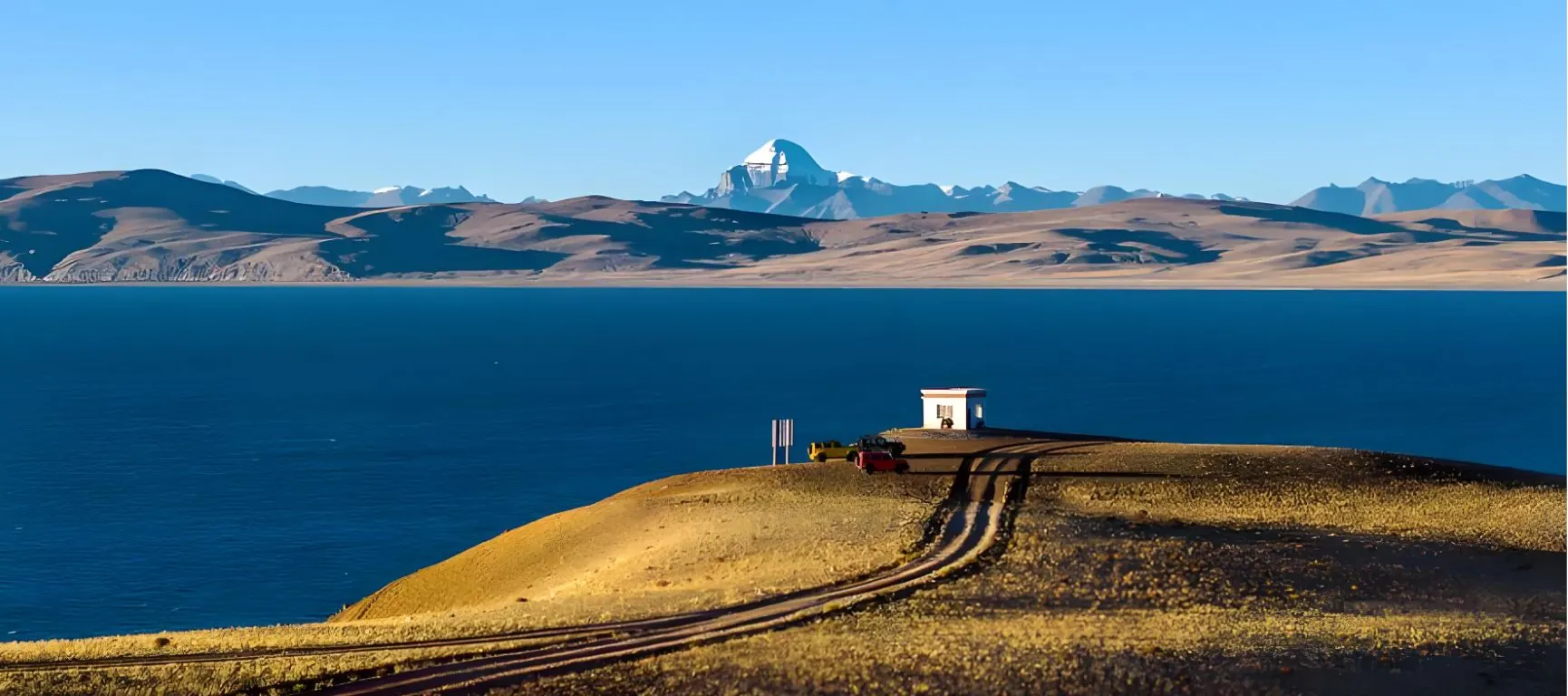
11 Days Kailash Kora Pilgrimage Small Group Tour
Fixed dates, guaranteed to run
The group meets in Lhasa on the date you choose below and travels with one Tibetan guide and one vehicle, never more than 8 people. Holding a seat is free; you pay the US$100 permit fee only when you confirm, 30 days before departure. The same tour also runs as a private trip on your own dates.
Hold a seat — no deposit →2027 departure dates
Each date is Day 1, the day the group meets. Fly in from Chengdu that day, or board the train in Xining the day before. Click a date to hold a seat on it.
farewell 25 May 2027 12 Jun 2027Saga Dawa Kailash Kora — No Everest
farewell 22 June 2027 14 Aug 2027Mid-August Departure
farewell 24 August 2027 4 Sep 2027Golden Autumn Departure
farewell 14 September 2027
Overview
A pure pilgrimage. Three days in Lhasa to get used to the altitude, then the highway west to Shigatse and the direct road to Saga and Lake Manasarovar, and the 52-kilometre kora around Mount Kailash in three days, over the Dolma La pass at 5,630 m. No detour to Everest: the Kailash region has holy lakes and glaciers of its own, and your time and strength are kept for the walk.
The kora is not a technical climb — no ropes, no scrambling — but it is a serious high-altitude trek, and the second day over the pass is long. Yaks and porters can be hired in Darchen to carry your main bag. The 12 June date is timed so that the first kora day falls on the Saga Dawa full moon.
Tour highlights
- ✓The full 52 km kora around Mount Kailash in three days, over the Dolma La (5,630 m)
- ✓Lake Manasarovar (4,588 m), one of the three holy lakes of Tibet
- ✓The north face of Kailash from Dirapuk, your closest night to the mountain
- ✓Three days in Lhasa first: Potala, Jokhang, Barkhor, Tibet Museum and the Sera debate
- ✓The direct road west — no Everest detour, no time lost
- ✓Back from Shigatse to Lhasa by train (ticket included)
Day-by-day itinerary
Day 1Arrive in Lhasa (3,650 m) — a quiet first day
Your guide meets you at Lhasa Gonggar Airport or the railway station and drives you to the hotel. The rest of the day is free: drink water, walk slowly, and let your body get used to 3,650 m. Lhasa hotel.
Meals: none
Day 2Lhasa — Potala Palace, Jokhang Temple, Barkhor Street
The Potala Palace on a timed ticket in the morning, then the Jokhang Temple and a clockwise walk around the Barkhor with the pilgrims. Lhasa hotel.
Meals: breakfast
Day 3Lhasa — Tibet Museum and the Sera Monastery monk debate
The Tibet Museum in the morning and the monks' debate at Sera Monastery after lunch. A third easy day in Lhasa is your preparation for the far west. Lhasa hotel.
Meals: breakfast
Day 4Lhasa → Shigatse (3,840 m) — a gentle step higher
West to Shigatse on the highway, a much shorter drive than the old road by Yamdrok and Gyantse, which this tour leaves out on purpose. Shigatse is a little higher than Lhasa, a gentle step up before the high plateau, and the short drive leaves the afternoon free to rest. Early night: tomorrow is long. Shigatse hotel.
Meals: breakfast
Day 5Shigatse → Lhatse → Saga — into the remote west
One of the long driving days that make western Tibet what it is. Through Lhatse, the last properly supplied town, and then north-west into emptier and emptier plateau: the Himalayan peaks to the south grow higher and more continuous, villages thin out, the road empties to the odd truck or a pilgrim walking west, yaks graze beside braided rivers and the sky gets wider by the hour.
Saga (4,640 m) is reached in the late afternoon, a plain administrative town on the upper Brahmaputra with basic but adequate rooms. This evening is practical: check your kit for the kora — poles, layers, medicines — and sleep early. Saga guesthouse.
Meals: breakfast
Day 6Saga → Lake Manasarovar (4,588 m) → Darchen
West again across the plateau until, without ceremony, Lake Manasarovar appears: 4,588 m, over 400 square kilometres, one of the highest freshwater lakes in the world and one of the three holy lakes of Tibet, formed, in Hindu belief, in the mind of Brahma. Even the least religious traveller goes quiet here. Time at the shore, for prayer, photographs or simply sitting.
A short drive north to Darchen (4,560 m), the small town where the kora begins. Permits are checked; yaks and porters can be arranged for the days ahead. A good dinner and the earliest night you can manage. Darchen guesthouse.
Meals: none
Day 7Kora day 1 — Darchen → Dirapuk Monastery (4,920 m), about 20 km, 6–7 hours
Your first long look at Kailash from Darchen: a symmetrical black pyramid dusted with snow, floating above the ridges in the morning air. The trail leads north into the wide Sarshung valley with the river alongside and the mountain growing with every kilometre. This is the kindest day of the three: a clear path, a gentle gradient and a manageable gain in height.
What stays with you is the company: prayer flags on every ridge and river crossing, mani walls carved with Om Mani Padme Hum, pilgrims walking in both directions, some fast, some in deep concentration, some prostrating full length the whole 52 km. Past the small Choku Monastery on the cliffs the trail rises to the Dirapuk guesthouse, and from here the north face of Kailash fills the window, a few kilometres away, huge and silent. Dinner is simple; the view is not.
Meals: none
Day 8Kora day 2 — Dirapuk → Dolma La Pass (5,630 m) → Zutulpuk, about 22 km, 8–10 hours
The hardest and holiest day. The route climbs steeply from Dirapuk through a valley thick with prayer flags to a great cairn piled with yak skulls, scarves and the belongings pilgrims leave behind as a way of letting go; most people pause here. Then the final climb to the Dolma La, 5,630 m, the top of the kora: nearly 800 m of height over rough, rocky ground with half the oxygen of sea level. Slow, steady, one step at a time; poles help, and your guide walks with you.
At the top the plateau spreads out in every direction, Kailash rises behind you and the holy lake of Gauri Kund lies in a hollow below. Flags cover everything; pilgrims pray, weep and laugh. Take the time you need. The descent on the far side is steep on loose stone, then the valley eases and the walk south-east to Zutulpuk, past the cave where Milarepa meditated, is calm and quietly satisfying. Zutulpuk guesthouse.
Meals: none
Day 9Kora day 3 — Zutulpuk → Darchen, about 10 km, then drive east to Saga
The gentlest section: an easy 10 km walk south along the broad outer valley back to Darchen, with prayer flags, mani walls and small shrines beside the path and other pilgrims coming down from the hills with the same quiet look. Arriving in Darchen closes the circle; the 52 km kora is done. For pilgrims of four religions this is a moment of great meaning; for everyone it brings a deep, quiet sense of having finished something that mattered.
After a short rest the vehicle is waiting. East past Lake Manasarovar on the road you came by, about five hours, to Saga for a hot meal and a long sleep. Saga guesthouse.
Meals: none
Day 10Saga → Shigatse → train to Lhasa
The longest day, but an easy one: you sit back and watch the plateau go by. About seven hours from Saga to Shigatse with stops, on the road you came out on, which looks different with the kora behind you. In Shigatse you board the train to Lhasa, about three hours; the ticket is included. You are met at Lhasa station and taken to the hotel, to more oxygen, a proper shower and a dinner with choices. Lhasa hotel.
Meals: breakfast
Day 11Lhasa departure
After breakfast your guide takes you to Lhasa Gonggar Airport or the railway station. Most travellers spend the morning replaying the journey: the north face at dawn from Dirapuk, the flags at the Dolma La, the stillness of Manasarovar at first light.
Meals: breakfast
What's included
✓ Tibet Travel Permit and all other permits for the route
✓ English-speaking Tibetan guide
✓ Tourist vehicle with driver for the whole tour
✓ 10 nights: Lhasa 4, Shigatse 1, Saga 2, Darchen 1, Dirapuk 1, Zutulpuk 1, twin share (breakfast in hotels; simple meals available at the guesthouses)
✓ Entrance fees for every sight in the itinerary
✓ Lhasa airport or railway station pick-up and see-off
✓ Oxygen in the vehicle and an oxygen canister per person; travel accident insurance
✓ Military permit for the Ngari (Kailash) region
✓ Train ticket from Shigatse to Lhasa on Day 10
✓ Guesthouses in Saga, Darchen, Dirapuk and Zutulpuk (basic, shared rooms on the kora); first-aid kit
✗ Flights or trains to and from Lhasa
✗ Lunches and dinners not listed (about US$3–15 each)
✗ Yak or porter hire on the kora, arranged in Darchen (about US$15–25 a day)
✗ Single room supplement (free for 5 rooms or 10+ travellers)
✗ Tips for the guide and driver
✗ Personal expenses and anything not listed
Questions travellers ask
How hard is the Kailash kora?
It is not a technical climb, but it is a serious high-altitude walk: about 20 km on day 1, 22 km on day 2 over the Dolma La at 5,630 m, and 10 km on day 3, on rocky and uneven ground with half the oxygen of sea level. Most travellers of reasonable fitness who have had three days in Lhasa first complete it without serious trouble. Walk regularly for six to eight weeks before you come, with some hills or stairs. Anyone with a heart or lung condition should see a doctor first, and if you are unsure, ask us.
Why does this tour not go by Everest, Yamdrok Lake or Gyantse?
Because the Kailash region has its own holy lakes and glaciers: Manasarovar lies right below the mountain, and the glaciers of the north face are in front of you at Dirapuk. So we take the highway straight from Lhasa to Shigatse and the direct road to Saga, and keep your days and your strength for the kora. If you want Everest as well, choose the 16-day Everest, Kailash and Guge Kingdom tour.
Which permits are needed for Kailash?
Three, all included and all arranged by us: the Tibet Travel Permit, the Alien's Travel Permit and the military permit for the Ngari region, which borders Nepal and India. Processing takes about 15 days, sometimes 20, so book four to six weeks ahead.
What are the Saga Dawa dates about?
Saga Dawa is the holiest month of the Tibetan year, and on its full moon, expected around 18 June 2027, the great prayer flagpole is raised at Tarboche, where the kora begins. Our 12 June departure is timed so that the first kora day falls on that day. The other dates, in mid-May, mid-August and early September, are chosen for clear weather.
Can I hire a yak or porter for my bag?
Yes, in Darchen at the start of the kora, for the three days; your guide helps arrange it. Carry only a daypack with water, snacks, warm layers, rain protection and medicines. At 5,630 m every unnecessary kilogram counts. The cost, about US$15–25 a day, is paid locally and not included.
What is the accommodation like on the kora?
Hotels in Lhasa and Shigatse; simple guesthouses in Saga and Darchen; and on the kora itself, at Dirapuk and Zutulpuk, very basic shared rooms with little heating and simple toilets. There is nothing else on the route, and after a long day most people find it does not matter.
How many people are in the group, and who are they?
Between 3 and 8 travellers, usually from several countries, with one Tibetan guide and driver for the whole tour. The same dates and prices are offered on our sister site tibettravel.com, run by the same office in Lhasa, so guests from both sites travel together in one group.
Do I pay a deposit to hold a seat?
No. Holding a seat is free. To confirm it, you pay the US$100 permit fee at least 30 days before departure, which starts your Tibet Travel Permit; the permit is included in the price. The rest is paid later, as explained on our how-to-book page.